


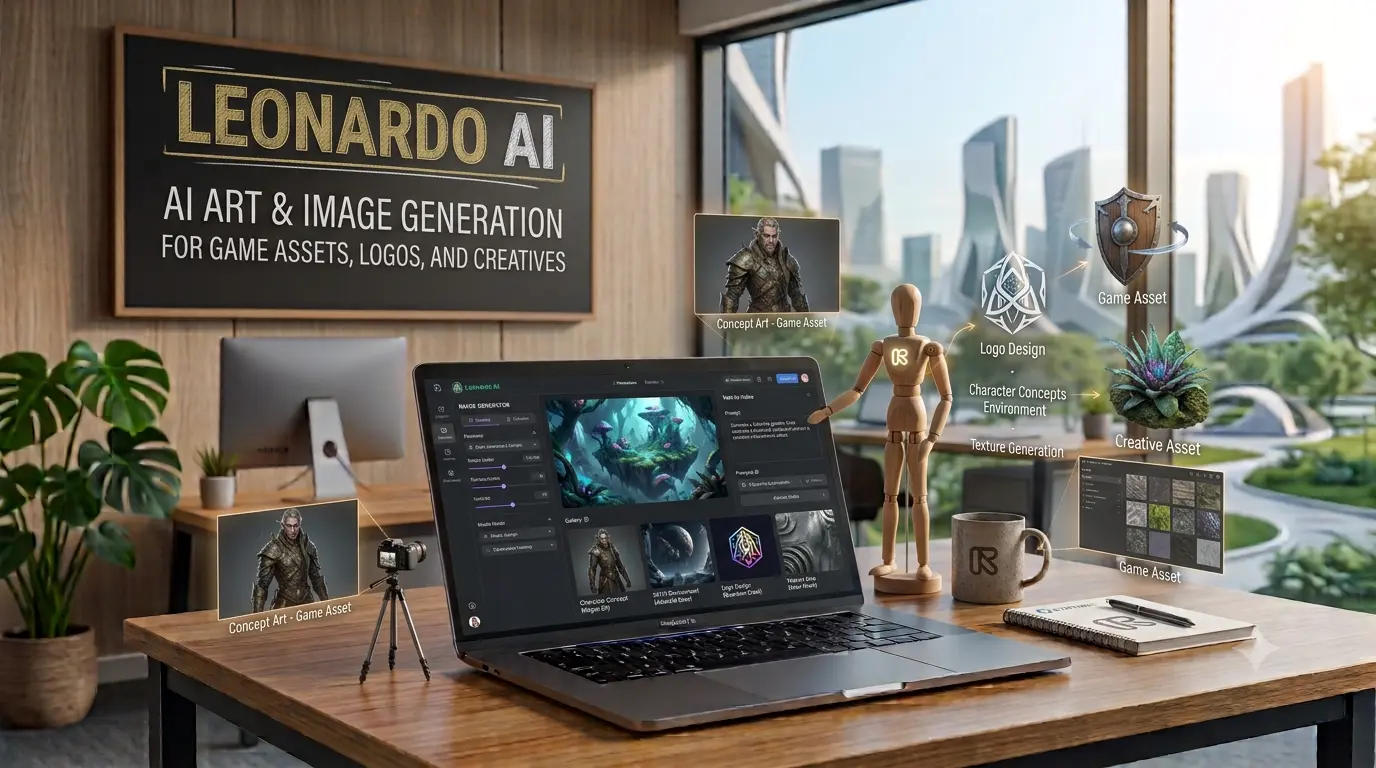
Leonardo AI: Your Ultimate AI Art Engine for Game Assets, Logos & Creative Projects
Tired of scrolling through endless stock photo sites, never quite finding the perfect image? Or maybe you're a game developer on a tight budget, dreaming of unique assets without the astronomical cost of a dedicated artist.
Welcome to the new renaissance of digital art. Leonardo AI is not just another image generator; it's a powerful, nuanced tool designed specifically for creatives, indie developers, and brands. It’s here to turn your imagination into stunning, high-resolution visuals at a speed that was once impossible.
In this deep dive, we'll explore how Leonardo AI is revolutionizing the way we create game assets, design logos, and fuel creative projects.
What Exactly is Leonardo AI?
Leonardo AI is a state-of-the-art AI image generation platform that uses sophisticated machine learning models (similar to technologies like Stable Diffusion) to create images from text prompts. But where it truly shines is in its focus on quality, control, and practicality for professional use cases. It’s built not just for experimentation, but for production.
Why Leonardo AI is a Game-Changer for Creatives
While many AI art tools exist, Leonardo has carved out a unique space by offering features that directly address the pain points of digital artists and developers.
1. Unleashing Unique Game Assets
For game developers, asset creation is one of the most time-consuming and expensive parts of the process. Leonardo AI changes the game.
-
Concept Art & Mood Boards: Rapidly generate environment concepts, character ideas, and creature designs to establish your game's visual direction.
-
Textures & Materials: Create seamless, high-resolution textures for wood, metal, stone, fabric, and magical surfaces. The AI understands prompts like "rusty iron plate texture" or "glowing runes on obsidian."
-
Items & Props: Generate icons for potions, weapons, spell books, and treasure. Need a "mythical glowing sword on a dark background" for your UI icon? Leonardo can do it in seconds.
-
UI Elements: Design unique frames, borders, and graphical elements to give your game a distinct interface.
The ability to generate hundreds of variations of an asset ensures you get exactly what you need for your game's world.
2. Crafting Distinctive Logos and Brand Assets
Every great brand starts with a great logo. Leonardo AI empowers entrepreneurs and designers to explore brand identities beyond traditional clip art and templates.
-
Ideation at Speed: Input your brand's name and a few keywords (e.g., "tech," "organic," "futuristic," "minimalist") and generate dozens of conceptual logo marks in minutes.
-
Iconography: Create unique icons for websites, apps, and marketing materials that are cohesive with your brand's style.
-
Full Brand Kits: Beyond the logo, generate patterns, backgrounds, and mascots that form a complete and unique visual identity.
Pro Tip: Use Leonardo to generate concepts, then have a human designer refine the best option to ensure it's scalable and perfect for print and web. This hybrid approach is incredibly cost-effective.
3. Empowering All Kinds of Creative Projects
The applications are endless:
-
Digital Artists: Use it as a brainstorming partner or to create base images to paint over and refine in Photoshop.
-
Marketers: Generate bespoke imagery for blog posts, social media content, and ad campaigns without licensing headaches.
-
Writers: Bring characters and scenes from your story to life to aid in description and immersion.
-
Hobbyists: Create art for D&D campaigns, custom merchandise, or personal projects.
Key Features That Set Leonardo AI Apart
What makes it so special for these tasks?
-
Pre-Trained AI Models: Leonardo offers specialized models fine-tuned for different purposes, like "Leonardo Diffusion" for photorealism or "RPG 4.0" for fantasy game assets. This means better results with less effort.
-
Precision Control with Canvas Editor: Go beyond simple generation. The built-in Canvas Editor allows you to inpaint (edit specific parts of an image), outpaint (expand the image canvas), and make precise adjustments, giving you an unprecedented level of control.
-
Texture Generation: A dedicated tool for creating seamless texture maps (Albedo, Normal, Roughness, etc.) ready for use in 3D engines like Unity and Unreal Engine.
-
AI Image Training: This is its killer feature. You can train your own custom AI model on a set of images (e.g., your unique art style, a company mascot). Once trained, you can generate endless new images in that consistent style—perfect for maintaining brand or game aesthetic.
Getting Started: A Quick Workflow for Game Asset Creation
-
Prompt Crafting: Be specific. Instead of "a sword," try "a detailed photorealistic dagger made of dragon bone with a glowing emerald embedded in the hilt, dark background, studio lighting."
-
Model Selection: Choose the "RPG 4.0" or "3D Animation" model for a stylized game asset.
-
Generate & Refine: Generate a batch of images, pick the best one, and use the Image-to-Image feature or Canvas Editor to make tweaks.
-
Upscale: Use the built-in upscaler to get your asset to a high resolution suitable for your game engine.
FAQ About Leonardo AI
Q: Is Leonardo AI free to use?
A: Leonardo operates on a token system. New users get a generous number of free tokens daily, allowing for substantial experimentation. Paid plans offer more tokens and premium features for heavy users.
Q: Who owns the images generated by Leonardo AI?
A: According to Leonardo AI's terms, users generally own the assets they create, including for commercial purposes. However, it is crucial to always check the most up-to-date Terms of Service on their official website for the definitive legal information.
Q: How does it compare to Midjourney or DALL-E 3?
A: Midjourney is often praised for its artistic and painterly style. DALL-E 3 (integrated into ChatGPT) excels at understanding complex natural language prompts. Leonardo's strength lies in its control, fine-tuned models for specific use cases (like gaming), and powerful editing tools like the Canvas Editor and custom model training.
Q: Do I need to be an artist to use it?
A: Not at all! While having an eye for design helps, anyone can learn to write effective prompts. It's a tool that amplifies creativity, regardless of your traditional art skills.
Q: Is it ethical to use AI-generated art for commercial projects?
A: This is an important ongoing discussion. The key is to use the tool ethically: be transparent about its use when necessary, ensure your prompts don't intentionally infringe on existing copyrighted characters or an individual artist's unique style, and always add your own creative direction and refinement. Leonardo is a tool, and like any tool, its ethical use depends on the user.
Conclusion: The Future of Creativity is Collaborative
Leonardo AI is more than a gadget; it's a powerful collaborator. It doesn't replace artists or designers but instead liberates them from creative blocks and tedious tasks. It handles the heavy lifting of iteration, allowing human creativity to focus on direction, emotion, and storytelling.